


Posts
Redesigning substance abuse treatment for the 21st century
05/13/2011
The face of substance abuse and addiction is rapidly changing.
“Legal highs” are becoming increasingly common, with the same dangerous side effects as illicit street drugs, reports the Wall Street Journal. Last year alone, the number of recognized legal psychoactive substances doubled in Europe. Powders, pills, salts-- you name it and they are being invented under the radar and sold, clandestinely, on the internet.
It’s the latest development in a perilous up hill battle for lawmakers, addiction specialists, and public health officials. With legal substances composed of chemical compounds similar to marijuana, cocaine, and ecstasy, the same addictive battle rages for those that use. The complexity of addiction recovery for mental health professionals who treat them, however, is more complex.
With the changes in addictive substances and overall substance abuse on the rise the field of addiction recovery must rise to the occasion to adapt and meet the needs of the community through effective measures … measures that will fail unless they are imbued with the values of humanistic psychology.
An epidemic of elder abuse -- through prescription drugs
05/12/2011The misuse of antipsychotic drugs on the elderly has been under scrutiny for some time now. Research reports, warnings by federal and state governments and physicians have apparently fallen on deaf ears.
According to recent research, millions of nursing home residents are being prescribed antipsychotic medications they don’t need – just to keep them docile.
Propublica, an independent nonprofit newsroom specializing investigative reporting for the public interest, published a blog May 10th, highlighting the troubles of nursing home care.
The New York Times also discussed a recent report issued by the Health and Human Services Department. The report reviewed the details from the largest medical care program for persons over 65 to determine just how many were receiving prescriptions for atypical antipsychotic drugs while they were living in nursing homes. These are drugs that have not been approved for use on patients with dementia … and in fact the FDA specifically issued a warning in 2005 that they should not be used this way.
A majority of nursing homes don’t appear to be listening.
Music is good for the soul -- and music therapy is good for the body
05/11/2011
Music is good for the soul – maybe that’s why new research shows it can also be healing.
A study published in the journal Music and Medicine featured a successful project that used music therapy with palliative (or hospice) care. Sandi Curtis, professor at Concordia University Department of Creative Arts, pulled together professional musicians to work alongside music therapists to provide 101 terminally ill individuals ranging in age from 18-101 years old with single music therapy sessions that lasted between 15 to 60 minutes.
The goal of the intervention was to relieve the pain, encourage relaxation, increase quality of life and improve mood. The results were positive, so positive that a few of the families and participants requested music be played at the time that they died. Music soothed the soul during one of the most deeply soulful and spiritual points in life.
Graduate College of Psychology and Humanistic Studies
05/10/2011Every individual has a unique role and influence in the world that can be realized through their life’s work.
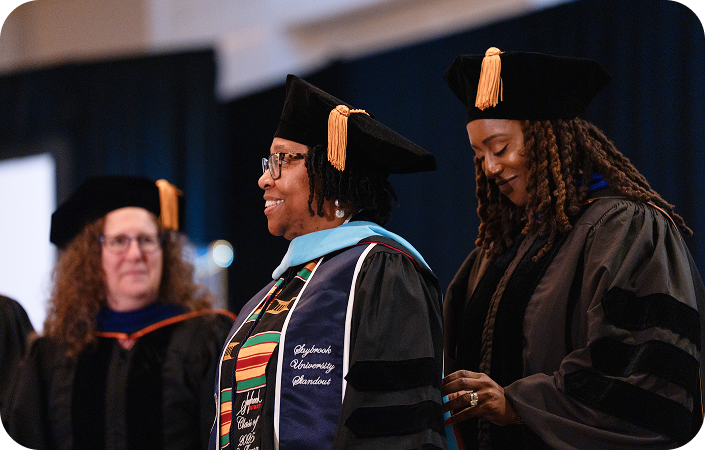
Saybrook’s College of Psychology and Humanistic Studies helps you find your passion, prepare for your career, and engage with the world to make it a better place.
The premier graduate university for education in humanistic psychology; a cutting edge pioneer in the study of organizational systems; and the only American university offer accredited degrees in Human Science (the European tradition of social sciences) – Saybrook’s College of Psychology and Humanistic Studies (PHS) offers a truly unique opportunity to advance one’s life’s work through humanistic study, scholarship, and activism.
PHS degrees are offered in low-residency programs, allowing students to study while remaining in their careers and without relocating. Students are required to attend a small number of Residential Conference each year for workshops, seminars, training, and intensives – and otherwise can complete coursework online.
PHS offers the following degrees:
In Psychology:
- MA Psychology
- MA Psychology, specializing in Creativity Studies
- MA Psychology, specializing in Jungian Studies
- MA Psychology, specializing in Marriage and Family Therapy
- PhD Psychology
- PhD Psychology, specializing in Clinical Psychology
- PhD Psychology, specializing in Jungian Studies
- PsyD
- MA Organizational Systems
- MA Organizational Systems, specializing in Leadership of Sustainable Systems
- PhD Organizational Systems
Students in any PHS program have the option of choosing a concentration in one of the following areas:
- Consciousness and Spirituality
- Humanistic and Transpersonal Psychology
- Integrative Health Studies
- Organizational Systems
- Social Transformation
Saybrook offers 11 certificates to non-degree students and to degree students seeking to enhance their education.
To earn a certificate, students need to complete four 3-credt certificate courses, one 3-credit practicum course, and a 1-credit integrative paper that ties course study and research together. Students will earn 16 units by completing a certificate. When appropriate, Saybrook students can transfer credits earned through a certificate towards their degree program.
Saybrook offers certification in the following areas:
- Building a Sustainable World
- Community Health and Development
- Creativity Studies
- Dream Studies
- Expressive Arts for Healing and Social Change
- Existential-Humanistic Therapy
- Jungian Studies
- Leading Organizational Transformation
- Organizational Consulting
- Peace and Conflict Resolution (International Focus)
- Violence Prevention and Response
For more information about Saybrook’s Graduate College of Psychology and Humanistic Studies, visit www.saybrook.edu, or contact an admissions specialist.
Why other people know you better than you know yourself -- and how it can help
05/10/2011
Others may know you better than you know yourself.
Researchers Simine Vazire and Erika Carlson explore this self-defining issue in an article published in the Current Directions in Psychological Science. (This study is actually a follow up to their 2010 study which was published in the Journal of Personality and Social Psychology).
In their 2011 piece, Vazire and Carlson suggest others have a better picture of who we are than we do. Why? Apparently we have a blind spot that is a result of what they refer to as “motivated cognitive process” in other words at some level we are motivated to not see all that we are. Those motivations can be conscious or unconscious, seen or hidden.
They suggest that we have a better concept of who we are internally, meaning we can tell what’s going on inside whether anger, anxiety or optimism. On the other hand, others have a better view of the external picture of us. For example, a good friend may tell you that you give off a confident energy when you may not believe that you do. According to this research your friend is probably right. But they are probably not picking up on what is going on inside you – all of that anxiety behind the confidence. This doesn’t mean the confidence is not there. It means that both are present and part of your experience.
Vazire research shows that across the board, others are able to give accurate impressions of one another: but here are exceptions.
Are good communication skills the foundation of psychological success?
05/09/2011
In conversation, as in life, it turns out that the little things matter a lot.
How you talk can make or break you. In fact, there is an entire science devoted to improving face-to-face communication – and it suggests that flawed communication is a major source of relationship distress and demise.
In Is Your Communication Style Affecting Your Relationship for Better or for Worse?, Dr. Sherrie Bourg Carter suggests that conversational styles and patterns in relationships are a major source of clandestine stress. Dr. Bourg Carter contends that many relationships and communications involve parties who are essentially speaking “a different language” depending on their level of directness, assertiveness, and compassion.
Dr. Bourg Carter is among many psychologists who suggest the importance of effective face-to-face communication for relationships and interpersonal fulfillment. It’s long been suggested that communication depends on the on “skill sets” or “talk habits” in one’s conversational repertoire.
In The Talk Book: The Intimate Science of Communicating in Close Relationships, author Dr. Gerald Goodman explores the skill sets needed for improved communication, transformed relationships, and fulfilled interpersonal relations. Dr. Goodman purports that changing six talking habits will transform all facets of your life.
Here’s some suggestions:
You can't diagnose a mental disorder the way you fix a toaster - but the DSM keeps trying
05/06/2011
It’s been a busy for the manual of mental disorders.
A new organizational framework was announced for the Diagnostic and Statistical Manual of Mental Disorders (DSM-5). Published by the American Psychiatric Association, it’s the book doctors look at to decide if you’re crazy and what medicine to prescribe for it. It may or may not be accurate – but it’s a big deal.
The newest version, now scheduled for May 2013, is proposing to restructure previous categories and chapters to reflect scientific advancements and hypothesized.
Sounds good, but there’s one big problem: the DSM has always been flawed, and the proposed DSM-5 looks to be no better.
The flaw is that it tries very hard to figure out symptoms, but no time at all trying to understand people.
There’s no empirical validation to this approach … and it’s packed with conflicts of interest to the drug companies who benefit each time a new symptom is deemed “treatable” by drugs.
It matters what the voices in your head are saying
05/05/2011
Have you ever been known or been with someone who was diagnosed as schizophrenic? Have they ever shared their experiences with you?
Have you ever wondered what that’s like?
Hearing voices or “auditory hallucinations” is the one aspect that
Can America come to terms with the post-911 reality it created?
05/04/2011
Emotions have run high since United States president Barack Obama announced the death of Osama bin Laden.
“The head of the snake is gone,” said Rudi Dekkers, the owner of the flight school that trained the two terrorist pilots responsible for killing thousands in the World Trade Center towers.
Bin Laden’s death marks a turning point of nearly a decade of grief, anger, and insecurity for all effected by the tragedies of 9-11. The tragic events of that day will forever be present as a reminder and a threat of the destructive capacities of terrorism.
But always remembering must not mean we stay locked in the past: Amidst great pain and fear, issues of remorse, forgiveness, and rehumanization are beginning to surface in light of the gross human rights violations that followed September 11, 2001.
In the Journal of Humanistic Psychology, author Pumla Gobodo-Madikizela draws on experiences from the South African apartheid to remind us what remorse, forgiveness and rehumanization look like in the aftermath of gross human rights violations.
There are no shortcuts to wisdom
05/03/2011
If you were wise, what would it be like?
I don’t mean “what would you know” – I mean “what would the experience of life be like?” Are wise people different from the rest of us? How do they live?
That’s the question Pscyhologist Dolores Pushkar set out to answer in a recently published piece: “What Philosophers Say Compared with What Psychologists Find in Discerning Values: How Wise People Interpret Life”.
Pushkar, Etezadi, and Lyster acknowledge that there is no consensus on what defines wisdom, but they propose the following as being key aspects; knowledge, deep understanding of human nature, life contentment, empathy and the flexibility to see issues from others’ perspectives.