Saybrook University is a proud member of The Community Solution Education System, a nonprofit system of colleges and universities working together to advance student success and community impact.
Find the field that’s right for you: Counseling, Psychology, Transformative Social Change, Integrative and Functional Nutrition, Psychophysiology, Mind-Body Medicine, or Integrative Social Work.
Online learning fueled by community and connection defines the Saybrook experience. Our learning model is designed to foster this collaboration and connection on a regular basis.
Your success as a Saybrook student is our top priority. These student services are yours to utilize, and they can help you thrive academically and personally in our learning environment.
Saybrook’s academic calendar includes weekly breakdowns of important dates, deadlines, and other calendar events you need to know as a member of our community.
International students enhance our learning environment. Learn more about the additional information you must submit to be considered for acceptance as an international student at Saybrook University.
The Ph.D. and DSW are both social work doctoral programs that allow graduates to gain more specialized knowledge in the field and pursue different job opportunities.
Students may struggle with deciding which of these two doctoral degrees in social work is the better option.
By laying out the basics, we can discover the difference between them and determine which program is the right fit for you.
What is a Ph.D. in social work?
A Ph.D. in social work is a doctoral program focused on research, education, social work policy, administration, and planning.
With a Ph.D. in social work, graduates are well-equipped to contribute to the ongoing academic conversation around social work through in-depth research and leadership skills.
A Ph.D. in social work elevates professionals in the field and develops key skill sets. Ph.D. programs in social work often maintain a focus on:
Evaluating social work methodologies
Conducting personal research in social work
Applying public research to contemporary issues
Assessing and synthesizing social work practices, interventions, and theories
Common career paths for graduates with a Ph.D. in social work include:
Training and development manager
Social work educator or professor
Researcher
Consultant
What is a DSW, or doctor of social work?
A doctor of social work degree, or DSW, offers students advanced training and practice in the field of social work. This education may involve research work but typically focuses on the application of social work principles and theory into leadership roles.
Common career paths for graduates with a DSW include:
Human services director
School social worker
Social work administrator
Advanced practice social worker
Nonprofit executive or administrator
The difference between a DSW and a Ph.D. in Social Work
While both result in doctoral degrees, there are some key distinctions between a DSW and Ph.D. in social work, including:
A Ph.D. in social work focuses more on developing students as researchers in the field. In contrast, a DSW is more practice oriented, focusing on clinical practice or social work applications.
A DSW prepares the student for administrative and leadership roles in the field, while a Ph.D. prepares the student for roles in academia in social work.
While both degrees hold many similarities, these are the most fundamental differences between them. Understanding these differences—and the most common resulting career paths—can help a student make the best choice for their education.
According to the Federal Emergency Management Agency (FEMA), the number of federal disasters rose 40% from 2000 to 2015. Social workers must be prepared to deal with the effects of many different kinds of crises, as climate change accelerates natural disasters, incidences of domestic terrorism rise, and the devastating impacts of COVID-19 compound.
Trent Nguyen, Ph.D., in Saybrook University’s social work course 1020: Disaster, Trauma, and Crisis Intervention, takes on that task, preparing future social workers to work with clients who are coping with trauma as a result of major negative events. His course lays the theoretical framework that will enable his students to assist clients struggling with such complex issues as suicide, sexual assault, violent behavior, intimate partner violence, substance abuse, grief, and mass tragedies.
“Social workers deal with clients who have trauma all the time, especially with what we are going through globally right now,” Dr. Nguyen says. “Not just the pandemic, but domestic violence, substance abuse, and child abuse are all through the roof.”
His course covers timely topics such as post-traumatic stress disorder (PTSD), sexual assault, bereavement, and school shootings. He also delves into the ways that cultural and social differences complicate social work, making cultural sensitivity an essential skill for any effective social worker.
“Help-seeking behavior is so different depending on one’s cultural and social background,” Dr. Nguyen explains. “Social workers have to be sensitive and humble to build rapport with their clients and cut across barriers and boundaries. These clients are looking for help but due to their background they may not know how to articulate that or how to ask for support. What we teach students is that with every person with whom they work, they must always start from scratch. They cannot make any assumptions whatsoever.”
Dr. Nguyen notes that social workers may see more than 15 clients in a day, and he teaches his students to be alert to the toll that can take on them. Burnout, vicarious traumatization, and compassion fatigue are common among social workers and can lead to issues such as substance abuse, distance from loved ones, depression, and numbness.
“When I was in school, we did not talk about secondary trauma at all,” he notes. “We were just trained to be present and provide quality services to clients. Now I want my students to realize that they also have some limitations. Most social workers have secondary trauma and they don’t seek help at all.”
Social workers often hear horrific stories and may struggle to leave those thoughts behind at the end of the day. A therapist who works with child abuse victims or a social worker helping military veterans may find themselves deeply impacted by what they learn in their line of work.
“For example, working with children who have been abused physically and sexually can impact professionals tremendously,” says Dr. Nguyen. “They bring these kids home with them, mentally and emotionally. They can’t get over it, can’t just forget it, and it can impact their personalities to a great extent. The reality is even though they don’t witness these events firsthand, their clients’ accounts impact them and the images stay with them.”
Dr. Nguyen teaches his students to build strong psychological boundaries to prevent compassion fatigue, and to use their peers and colleagues as a mutual support system. “One of the things I emphasize is that in this profession we cannot act as ‘Lone Rangers.’ We have to provide support to our peers and seek their support as well because there’s no way we can see dozens of trauma clients and at the end of day say that it doesn’t impact us at all,” he says.
Processing professional experiences with trusted peers allows social workers to tackle the secondary, vicarious trauma that would otherwise build up and calcify, leading to deeper impacts. Dr. Nguyen points out that acknowledging your limitations and accepting help and support will allow you to be a more effective social worker for your clients in the long term.
At the end of a year in which the U.S. saw hospitals overwhelmed, hundreds of thousands of deaths, millions of jobs lost, and a corresponding surge of domestic violence and mental health problems, social workers who are equal to the moment can make a huge difference. While global disasters may often be viewed as singular events, they are also composed of millions of personal tragedies in the lives of individuals who come from diverse backgrounds and disparate cultures. SW 1020 helps future social workers amass the tools needed to help these individual sufferers without compromising their own mental health and to be able to provide help by knowing when to ask for help themselves.
The Greeks coined the term utopia to mean “no place.” It became colloquial and used in conversation in 1516 when Sir Thomas Moore wrote a two-volume book on the perfect society called Utopia. He wanted to wax and wane about the various considerations of how a perfect society would coalesce. Moore used the term utopia to allude to the fact that there is no such thing as a perfect society. Yet, what is morality? What is good and bad? How do we define these terms? The history of their meanings has evolved as time has passed, and with a bevy of philosophers offering research and social hypotheses, we must accept that it is based on ethics and current culture. As we progress forward from century to century, ethics and values change, but our interest in morality does not.
Are we good or bad?
When we start the debate on whether humans are inherently good or bad, we should start with Thomas Hobbes’ and John Locke’s debate about the government and its interaction with people. According to Hobbes, people are vile beasts. Therefore, it is necessary for government to be very much involved in protecting people from themselves.
Locke later proposed that people are in fact good. Therefore, government can take a step back. He believed that if people have to interact with others they’ll make the right choices because they know what’s good.
The interesting part of this debate is that with Hobbes’ idea, people are “vile beasts” and the government needs to be involved, but the government is made up of people. So how are they to protect people if they themselves are vile beasts? The main consideration was Locke offering this idea that people will do what’s good. And the real question against Locke is: How do you define what’s good?
What is good?
When young parents were asked to convey the most vital element of a child’s social development, morality was at the top of the list. Morality is the capacity to make evaluations about what is right or wrong and to act in accordance with what is deemed right (Broderick and Blewit, 2015). When we start to approach the idea of learning morality, we give this broad definition in terms of what is right. When we anchor morality around what is good, then we must posit that it is dependent upon values and ethical codes, which further obscure and complicate these ideas of right and wrong. But only through this understanding can we begin to consider how people make moral decisions.
One theory about this decision-making process is the Social Intuitionist Model (SIM) from Jonathan Haidt (2001). Haidt posits that a set of causal links join three psychological processes, namely intuition, judgment, and reasoning. SIM advances the notion that intuition is the driving force behind moral judgment, and once that judgment has been made, reasoning sets in post hoc.
Joshua D. Greene developed an alternate theoretical model called the dual processing model of moral judgment, which holds that morality can be impelled by cognition and not intuition. Current research highlights the role of emotion and intuition in moral adjudication, countering research that cognition and reasoning are the most integral considerations of determining morality (Paxton and Greene, 2010).
Natural intuition
According to Haidt, the argument for the decision—the logical part—only comes after you’ve made the decision. There’s a set of causal links—intuition, judgment, and reasoning. Intuition makes you feel something, which generates the judgment you have about it, which then forces you to come up with a reason for your feeling and judgment.
As a determinist, Haidt’s perspective posits that cognition never really plays a role. A determinist believes that our decision-making is very narrow—meaning many unconscious mechanisms are at the core of the way we navigate life. So it makes sense that he would believe intuition would be the way that people would make decisions as opposed to the logic. Rational thought is really not deterministic; it’s more of an autonomous means of how people experience life.
Intuition is a limbic indicator—an emotional beacon that points you in the right direction. … The origination is not coming from a rational argument; it’s how you feel about the question.
Intuition is a limbic indicator—an emotional beacon that points you in the right direction. SIM establishes that after you limbicly, or emotionally, conclude something, you generate an argument. The origination is not coming from a rational argument; it’s how you feel about the question. SIM considers reasoned moral judgment to be a rarity, no matter the circumstances within an individual. According to the SIM principle, morality that guides behavior is intuitive, and no cerebral reasoning will alter another person’s behavior unless that
person has a change in sentiment.
The dual processing model disagrees with this presumption and advances that dialogic reasoned intercourse on morality can change a person’s thinking, which engenders a new sentiment (Paxton and Greene, 2010).
Cognition and rationality
Paxton and Greene’s dual processing model does not discount the fact that the way you feel about a question is involved in the decision, but adds that one can use moral logic in order to come to a conclusion prior to the decision. This is a key component when discussing changing someone’s mind as well. There must be rational thought in order for it to be possible.
Paxton and Greene (2010) conveyed an example of Martin Luther King Jr.’s “I Have a Dream” speech as a modality of changing someone’s perspective. The use of imagery and metaphor engages the emotions of others as a way of altering perspective. Paxton and Greene (2010) suggest that in reality it is not possible to say that emotion alone is the deciding factor when engaging another person. The reason is because emotional decisions can lead someone to make choices without considering the morality of the decision. For a person to engage another person and alter moral tenets, reasoning must be employed and is accomplished by the “pain of inconsistency.”
Another consideration was advanced by Pizzaro, Uhlmann, and Bloom (2003) who studied people’s reaction to the fictitious case of Barbara who wanted to kill her husband John. She slipped poison into his food at a restaurant. The poison was not strong enough to kill him, but it impaired the taste of the food, causing him to change his order. The exchanged food is something that John is allergic to, and he dies after eating it. When participants evaluated this scenario initially, they indicated that it appears Barbara is less blameworthy for her actions; nevertheless, they could not logically explain their intuitive judgment. However, when participants were asked prior to make a rational moral judgment, they were unlikely to say that Barbara was less blameworthy, citing her intention as a prime reason for her moral mea culpa.
This buttresses the dual processing model of social influence of moral reasoning in that it was the instruction the researchers gave prior for making a rational moral judgment (social discourse) that elicited an altered cognitive response by the participants. Paxton and Greene (2010) further cited various studies of brain scans during moral reasoning before judgment was made, which found activity in the dorsolateral prefrontal cortex. This is an area identified with cognitive processing. If SIM was correct, then this activity should occur after the moral judgment has been made.
Cultural impact
As we know, an integral element regarding moral reasoning is culture. According to Zhang and colleagues (2013), major distinctions exist between different cultures in moral reasoning. They give an example of a moral dilemma told to Chinese and American fifth grade students. Thomas was a poor child who never won anything in his life and who had few friends. Thomas finally gets a chance to win a model car making competition; however, he does not do so fairly because he has help from his brother. Thomas tells his secret to Jack. The moral question asked is if Jack should tell on Thomas.
Initial reactions by Chinese students were allocentric, namely that their concern for Thomas was initially centered on a collective perspective. Chinese children concluded that Jack should tell on Thomas so that it will help correct his ways and make him a better part of society in the future. Americans were more idiocentric, namely that their concern was centered on an individualistic perspective. Americans thought that Jack should not tell because he would get in trouble with Thomas.
These reactions are in line with the collective element of Chinese culture and the individualistic mindset of American culture. Nevertheless, collaborative discussions regarding moral reasoning helped to modify and clarify subsequent behaviors within groups. This means that rational and logical dialogues aided each group to consider alternate ways of viewing the story and subsequently modify perspectives. This example suggests that the dual processing model regarding the social influence of cognition on morality is accurate.
The therapist’s dilemma
As clinicians, the division between SIM and the dual processing model becomes integral regarding the approach that the clinician will use when contending with the moral tenets of the client. The question is: Should the clinician engage the client’s intuitions, or should the clinician focus on reason and logical discussion?
In advancing the notion of the dual processing model as an implementation of addressing morality in the therapeutic environment, one must be cognizant of moral development. When we think back to how importantly parents ranked teaching their children morality, it’s important to remember this cognizance.
According to Piaget (1932) and Kohlberg (1981), moral development is a cognitive process. Piaget advanced that children are initially egocentric in cognition, and punishment is not connected to any specific act but instead an arbitrary response imposed by powerful adult authority figures. The end of the preoperational phase (age 7) is when children start to understand the interplay between action and consequence predicated on mutuality rather than arbitrary elements. This is an extension and development of the theory of mind where a child can recognize others and their perspective and intent.
Callender (2002) suggests that depressed people, who Beck (1979) understood to be those who had a negative opinion of themselves, of the world, and of the future, may need to graduate from Piaget’s first moral stage of powerful authority figures to the second stage of recognizing others’ point of view through mutuality. Piaget’s third level, which is about age 10 or 11, is when an appreciation for rules develops and the potentiality that they can change through consensus.
In therapy, many times people couch their circumstances through a moral lens, asking, “Did I do the right thing?” Or simply saying, “I’m bad,” especially when discussing addiction or even in marriage therapy.
In therapy, many times people couch their circumstances through a moral lens, asking, “Did I do the right thing?” Or simply saying, “I’m bad,” especially when discussing addiction or even in marriage therapy. Whiting (2008) advanced that in a clinical setting focused on couples’ therapy, couples spoke in moral terminology regarding responsibility for behavior and regarding their self-appraisals. Many times, people on the defensive bend morality or modify the recollection of an episode in order to bring confluence between an event and a personal moral tenet.
Callender (2002) advances that this is common. Persons who hold a belief about being failures will modify praise and progress as either not genuine or as a disappointment because of some perceived flaw. Clients who behave in conflict with moral principles, for example with violence and aggression, may rationalize that their behavior is defensive and that the victim was deserving of this consequence to be free of moral impingement. It could also be that the moral stage in which a client is situated impedes understanding of the moral imperative of respecting others.
As a therapist, it’s important to recognize the role that the concept of good and bad may have in the conversation. However, “utopia” does not exist. There is no morally right society or set dichotomy of good and bad. When we consider the ways that the dual processing model affects our patients, we can more adequately assist them in their journeys.
About Rabbi Ron Finkelstein
Rabbi Ron Finkelstein serves as the director of a mental health and addiction clinic in Brooklyn, New York. Rabbi Finkelstein earned his master’s degree in clinical mental health counseling at Touro Graduate School of Behavioral Science and is currently obtaining a doctorate in clinical psychology at Saybrook. His research is focused on religion and psychology.
There are many specializations for these programs as well, for those interested in honing their education in specific disciplines, such as consciousness and spirituality, creativity and leadership, complex trauma and healing, and others. Learn more about our expansive psychology programs.
Barrett, M. J., Trepper, T. S., and Fish, L. S. (1990). Feminist-informed family therapy for the treatment of intrafamily child sexual abuse. Journal of Family Psychology, 4(2), 151.
Beck, A. T. (Ed.). (1979). Cognitive therapy of depression. Guilford Press.
Broderick, P.C., and Blewitt, P. (2015). The life span human development for the helping professionals. Upper Saddle River, NJ: Pearson.
Callender, J. S. (2002). Cognitive ethical therapy? The role of moral judgements in cognitive therapy. Clinical Psychology & Psychotherapy, 9(3), 177-186.
Davis, S. D., and Piercy, F. P. (2007). What Clients of Couple Therapy Model Developers and Their Former Students Say About Change, Part I: Model‐Dependent Common Factors Across Three Models. Journal of Marital and Family Therapy, 33(3), 318-343.
Fowers, B. J., and Olson, D. H. (1993). ENRICH Marital Satisfaction Scale: A brief research and clinical tool. Journal of Family psychology, 7(2), 176.
Fulford, K. W. M. (2000). Teleology without tears: Naturalism, neo-naturalism, and evaluationism in the analysis of function statements in biology (and a bet on the twenty-first century). Philosophy, Psychiatry, & Psychology, 7(1), 77-94.
Goldner, V. (1999). Morality and multiplicity: Perspectives on the treatment of violence in intimate life. Journal of Marital and Family Therapy, 25(3), 325-336.
Greene, J. D. (2007). Why are VMPFC patients more utilitarian? A dual-process theory of moral judgment explains. Trends in cognitive sciences, 11(8), 322-323.
Haidt, J. (2001). The emotional dog and its rational tail: a social intuitionist approach to moral judgment. Psychological review, 108(4), 814.
Jory, B., and Anderson, D. (1999). Intimate justice II: Fostering mutuality, reciprocity, and accommodation in therapy for psychological abuse. Journal of Marital and Family Therapy, 25(3), 349-364.
Kant, I. (1785). On a supposed right to lie because of philanthropic concerns. Indianapolis: Hackett.
Kohlberg, L. (1981). The meaning and measurement of moral development (No. 13). Clark Univ Heinz Werner Inst.
Paxton, J. M., and Greene, J. D. (2010). Moral reasoning: Hints and allegations. Topics in cognitive science, 2(3), 511-527.
Piaget, J. (1932). The moral development of the child. Kegan Paul, London.
Pizarro, D. A., Uhlmann, E., and Bloom, P. (2003). Causal deviance and the attribution of moral responsibility. Journal of Experimental Social Psychology, 39(6), 653-660.
Power, M. J., and Dalgleish, T. (1999). Two routes to emotion: Some implications of multi-level theories of emotion for therapeutic practice. Behavioural and Cognitive Psychotherapy, 27(02), 129-141.
Sharf, R. S. (2016). Applying career development theory to counseling. Cengage Learning.
Whiting, J. B. (2008). The role of appraisal distortion, contempt, and morality in couple conflict: a grounded theory. Journal of Marital and Family Therapy, 34(1), 44-57.
Yalom, I. D., and Josselson, R. (2011). “Existential Psychotherapy” in Corsini, Raymond, and Wedding, Danny: Current Psychotherapies.
Zhang, X., Anderson, R. C., Dong, T., Nguyen-Jahiel, K., Li, Y., Lin, T. J., and Miller, B. (2013). Children’s moral reasoning: Influence of culture and collaborative discussion. Journal of Cognition and Culture, 13(5), 503-522.
Some conversations are too vital to use the wrong language. We’re not just talking about the difference between your and you’re, but the very important words used to define generations and movements.
Social movements have many waves, like first-wave feminism and the divisive second and third waves. The fight for Black people’s rights is much the same. 2020 has seen the continuation of the fight for racial justice. The civil rights era brought a lot of progress, but it never truly ended racism, just changed the way it appeared in everyday life.
With the death of George Floyd and other racial trauma during COVID-19, we’ve seen a distinct rise in protests and demands not just for the end of racism, but for an antiracist society. Not a new term but brought to the front of our collective repertoire perhaps. Antiracism wasn’t the only term that came to the forefront this year. We also began to explore deeply what being an ally and an accomplice really means.
Two leaders in the Saybrook community discuss what the language and the narrative around the fight for racial justice means to them and how they see the movement pushing forward.
Theopia Jackson, Ph.D., is a licensed clinical psychologist who received her master’s degree in clinical psychology from Howard University, Washington DC, and her doctorate from the Wright Institute in Berkeley, California. She is currently the Co-Chair of the Department of Humanistic & Clinical Psychology and Chair of the Clinical Psychology degree program at Saybrook University in Pasadena, California. Dr. Jackson is the 2019 – 2021 President for The Association of Black Psychologists, Inc. (ABPsi) and past president for the Bay Area chapter.
Deja Jones is a third year Ph.D. student in the Transformative Social Change Department. Her research interests focus on creating alternative education systems that provide equity in Black and Brown communities. She teaches youth organizing in partnership with community-based organizations across New Jersey.
On ally vs. accomplice
Deja Jones: When we think about an ally, there’s a limitation. Being an ally is taking the first step to awareness. You’re someone who is not a part of a marginalized community so you’re coming into this awareness that there’s something wrong, but also acknowledging that there are groups of people who have had to live and navigate through these spaces. So the first step is to seek to understand this new awareness.
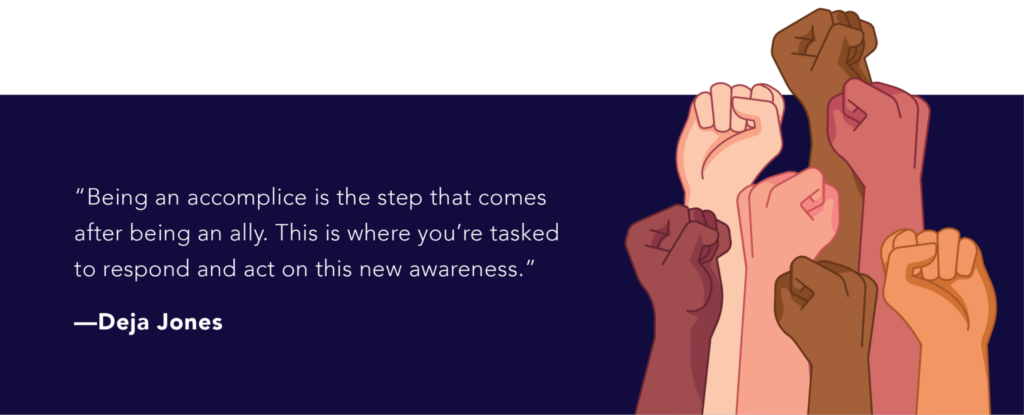
Being an accomplice is the step that comes after being an ally. This is where you’re tasked to respond and act on this new awareness. It’s one thing to know and understand or try to understand what’s going on in terms of racial injustice here in America, but it’s another thing to be out there on the ground or doing your part in actually changing the structures.
When you’re an accomplice to the fight for racial justice, that means you’re in the room with us, strategizing and planning. And you’re also out there in the field acting and changing the infrastructure of things.
I think both words are needed, but it’s the step before the step. We want allies. We want people who are aware. We want people who understand. People want to be a part of these movements with us, but it can’t just live in a space where you read a book about it or you watch a video about it.
Dr. Theopia Jackson: Language is important in our country. It drastically informs thought and action. But I also worry because when we start using labels so freely, we have lost the person and we’re dealing with the label.
I understand the rationale for adopting the concept of an accomplice in antiracism, yet I have some concerns. The term accomplice in historical context in our country has a negative connotation to it. It’s always aligned with people getting together to do something wrong. It’s never been used in a celebratory space.
To me, allyship is not a permission to step in front of us and to protect us and to save us. To some people, it makes them feel good when they’re able to take care of others, but in a way that’s about them feeling good. That would be the qualitative difference between ally and accomplice. Whereas someone who’s wanting to help take care of others simply for the idea of the other person being safe is an accomplice. In this situation, one does not fully understand what it means to be a cultural ally, which includes self-reflection before action.
The person who has a savior complex is preoccupied in some ways by getting seen by others. Whereas others who may step out are not there to be heard or seen. One of the images I have greatly appreciated during this time of a more heightened racial pandemic is the wall of white mothers who stood between law enforcement and protestors, the Wall of Moms. They’re trying to keep everybody safe. I didn’t hear any of them in the media saying, “Well, you know, we’re good people we want to do something.” None of them were taking credit.
Words matter. So another side of the coin is the term minority. I have a problem embracing it, saying to my child, “You are a minority.” I’m not a mathematician, but I know enough to know if I’m using the word minority, from a psychological perspective, this means somebody out there is more than me.
This becomes even more complex if you’re looking at statistics from around the world, a reverse relationship in terms of people of color or ethnic groups in relation to white Americans, which is the way we always couch these conversations. White versus Black, white versus something. In this context, with the projected ethnic populations, it may inadvertently perpetuate some misperceived threat to those who identify as white Americans.
As we get better, we have to do better. We must continue to challenge ourselves—acknowledge that these terms may not be as helpful anymore because they have a psychological messaging to them.
On action
Jones: There’s a quote by Audre Lorde: “We are not responsible for our oppression, but we must be responsible for our own liberation.” She also talks about how it’s not the responsibility of the oppressed to educate the oppressor. But I think what’s interesting is that when we take on that approach, we’re missing out on the importance of relationship building too. When we disassociate from what’s going on, that’s where white savior complex tends to sprout up.
We’re asking people who aren’t marginalized to give up some of their privilege to help equalize or promote equity and liberation for people who are marginalized. When we’re constantly saying that to people who aren’t oppressed, it creates this idea that “I have to do my part. I have to come in here and do this, do that.” The term ally in some way can play into white savior complex, which is why I said the term can be very limiting.
It requires additional steps beyond learning and understanding. But you’re not working outside the bubble of racial justice—you’re inserting yourself into it, to be a part of change.
On self-actualization
Dr. Jackson: The idea of self-actualization is critical in the fight for racial justice. It means I’m going through my own transformative process, gaining greater insight into who I am, being able to decide who I want to be and how I’m going to be in terms of my own meaning-making and self-determination. If we accept the reality that racism impacts everyone, it becomes part of everyone’s personal self-actualization. It just manifests itself differently. This can lead to deeper levels of change/transformation and promote collective-actualization.
We have evidence to demonstrate the psychological, spiritual, physical, and economical impact that a group or a person in a group can experience just by fact of being in that group—in this context where we’ve targeted them. What we haven’t paid enough attention to is what is the impact on the psyche and the spirit of the person who’s perpetuating racism. Or the person who is colorblind to it, or the person who thinks the work is done because of the civil rights movement. To paraphrase a quote (I have lost the awareness of the author): “Evil flourishes when good people stay silent or do nothing.”
All of us have been impacted by what I call white supremacy ideology. Hear that clearly. It has affected all of us. We have to critically interrogate that and unpack it. It doesn’t mean that we turn everything on its head. It doesn’t mean that everything flip-flops or we’re annihilating our “American way.” For example, we have an awareness of how being subjected to oppression or racism can impact the person or group. However, we are less aware of or even curious about how it impacts the person or group who embraces racist ideology. What is happening to their psyche, spirits, and their future generations? What it means, if we unpack it clearly, is that we may be in a better position to actually live the American dream and live it in a more humane collective way.
The real question should always be, how do I locate myself in this? How is it affecting me? And as I better understand that, then how can I be more clear about what I’m going to do to help my own growth and the growth of humankind?
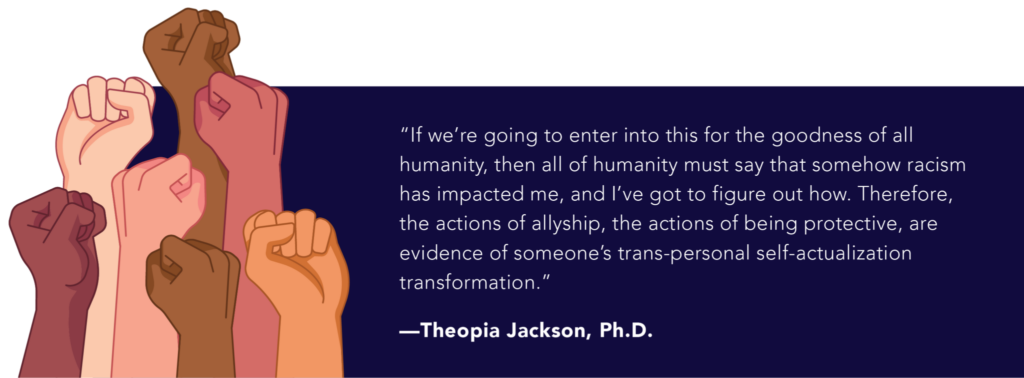
If we’re going to enter into this for the goodness of all humanity, then all of humanity must say that somehow racism has impacted me, and I’ve got to figure out how. Let go of the temptation to defend oneself of not being a racist and embrace the realities that we have all been exposed to racist ideology and culture (beliefs, values, practices, etc.). This is what feeds implicit bias. Therefore, the actions of allyship, the actions of being protective, are evidence of someone’s trans-personal self-actualization transformation.
We have to be brave enough, courageous enough, innovative enough, to do something different that can allow us to have greater societal and deep level change. I believe we have to go beyond ally or accomplice to self-actualization transformation that can then lead to collective-actualization and societal transformation so that we can have a more humane just world.
On generations
Jones: One thing I’ve reflected on as well, especially when it comes to racial injustice in America, is that with every generation there is an uprising. There was an uprising for my mom’s generation, my grandparents, great-grandparents, and at the surface it’s always about racial injustice. I think now at least for my generation—millennials—we’re now past a place where we want to continue having conversations about racial injustice. We want more.
We also don’t want to settle for reform because that’s clearly not the answer. Now we’re moving from reform to a place of dismantling, and we’re asking—how do we dismantle systems? How do we disrupt systems? How do we interrupt processes? Because on the surface, we are destroying something, but it’s for the betterment for everyone.
Because we’ve been so accustomed to living the way that we are, it’s almost difficult to reimagine something different.
Even from my lens as a Black American, there is a generational divide when it comes to the fight for racial justice. My thoughts and beliefs might be seen as radical to someone like my grandparents or my great-grandparents. So in this instance, even the word accomplice refers to all of us Black people as we try to move all generations from a place of complacency to a place of action.
But what’s happening in terms of the racial uprising can be very traumatic or trigger inducing for older generations who’ve had to live through their own struggle with racial injustice in America. But I think the uprisings happen every generation because with each we reach a certain pinnacle and we think that that’s it. “The work is done. We can sit down now.”
But then something else comes about and now we’re activated to act again. I’m having conversations with non-Black people about racial injustice in America and what that looks like in all different fields, but I’m also having these conversations with family and friends who are Black. There’s a learning gap.
At least for me as a Black person, I think my Blackness is what automatically makes me marginalized, but I also don’t have all the answers. I don’t have all the tools or all the resources to give, so it’s a learning experience for me too.
I think it’s about us equally doing our part where it’s, “OK, I can give you resources. I can point you in direction of things that you might find interesting, but I also acknowledge that I don’t have the capacity to be a full-time teacher for you in this process.”
While it’s not a Black person’s responsibility to educate, I do think that we can do our part. Allyship and accomplice is about relationship, and you can’t have a relationship with just one person. I think that we have a shared responsibility in this. I know we’re tired, but we also have a shared responsibility to make sure that we are working together to bring about a change.
On finding yourself in the conversation
Dr. Jackson: I’m more interested in all of humanity, all of America asking itself, how has racism impacted me. More specifically, how has systemic racism impacted me? Because systemic racism, just like culture, is like amniotic fluid.
We’re not raising white children saying, “OK, let me let you in on a secret. You’re winning things because you’re on the good side of the systemic oppression and racism that would perpetuate.” That’s not happening.
But they are being raised in a racist culture. They are being socialized into that. If you hear the name, Susan versus Theopia, it brings these facts to light. People will always say, “I treat everyone equally.” But if you can’t even say my name or take liberties to shorten it to Theo or not recognize that you may have made some assumptions about who I am before you meet me, then you are acting from bias; you already have some thoughts about me.
In my own experience, I’ve had many interactions where someone will change my name to a nickname without asking—particularly white people. Other examples are the prevalence of white people touching our Black children’s hair without asking or the questioning of “what are you?”
These are examples of unexamined privilege. Privilege is not defined by how much money you have. It is defined by what you have to pay attention to and what you don’t. What doors get opened for you because of a certain membership in an organization, even though you may still be poor in America.
You see this when we look at health care. If we’re looking at the mortality rates for pregnant women in terms of being able to deliver healthy live babies, across the board, white women, even uneducated and living in poverty, have a higher live birth outcome than educated Black women. They can even see the same doctor yet the disproportionate outcomes occur and research has demonstrated that it is not about Black women’s problems but more about the quality of interactions within the health care industry. That’s privilege.
Jones: Fighting for racial injustice requires decentering, and decentering is an ongoing process. It’s really difficult to decenter because we’re human and we feel things and we want to share our feelings and our thoughts and our opinions. At the same time, it’s important to read the room and know where you’re at in this process.
After the George Floyd video, I found myself in many group conversations as the only Black person. And for many of them, it was the first time that people were exploring the history of Black oppression—which was an emotional enlightenment for many. It became about what they were experiencing versus what the experience of the people who are actually suffering are experiencing.
Decentering requires you to acknowledge how everything is making you feel, and what you’re learning and simultaneously understanding the privilege of not actually having to experience it every day.
Now we’re challenging white people to step up and be a part of dismantling this racist system, but we’re not telling you to step up to the microphone or to be the mouthpiece for all things oppressed. Decentering is being able to sit down and listen. It’s asking people how they’re feeling and not asking to respond, but listening.
When white people step up to the speaker box to be centered in this movement, it really hurts the movement. It’s about walking beside marginalized people and not trying to lead us to where you think we should be.
On learning
Dr. Jackson: As a humanistic developmental psychologist, I’m always of the mindset that the more we know, the more we don’t know and the more potential we have to know. There is no end zone.
When I think about the time of enslavement, we talk a lot about the hanging of the body, but I also think about what is going on in the psyche of that child, that white child who’s watching the Black body being hanged. What’s going on as they grow up, as they become parents? How is that showing up today?
We’ve never fully looked at that in the field of psychology. Perhaps if we had, America would not be sitting in this moment, because I would submit that this is happening under our watch as psychologists. Our science is not deep enough or good enough in this moment to meet such complexities. There is more for us to learn.
We have to critically understand how white supremacy took hold in someone. Some void is being filled with this ideology—some sense of self being satisfied. In some ways we, as a society—more than just parents—we as a society missed something. How did we not see what was happening to the psyche of that developing child that led to these adults? That led to a sixteen-year-old showing up with a gun in the middle of a protest.
That’s on us. That’s on our science. That’s on our health care system. That’s on our mental health system. That’s on our educational system. That’s on our family. It’s a collective problem.
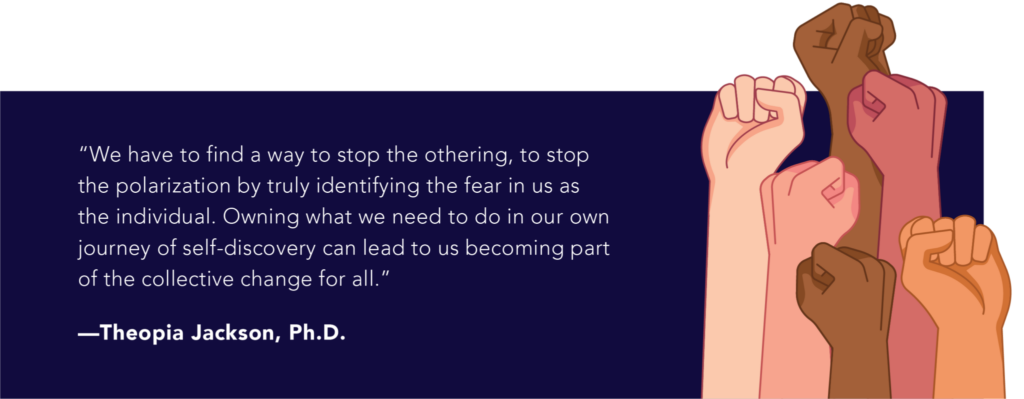
We have to find a way to stop the othering, to stop the polarization by truly identifying the fear in us as the individual. Owning what we need to do in our own journey of self-discovery can lead to us becoming part of the collective change for all. In closing and reflecting on this moment in American history, what woke us up, and how do we stay woke long enough to effect genuine transformational change?
Learn more about Saybrook University
If you are interested in learning more about the community and academic programs at Saybrook University, fill out the form below to request more information. You can also apply today through our application portal.
As we enter 2025, what should we actually expect? Drake Spaeth, Psy.D., offers insight into the traditions surrounding new beginnings.
Resolutions usually fall into the benign. According to YouGov, some of the most common resolutions are resolving to exercise more (50%), saving more money (49%), eating more healthily (43%), losing weight (37%), and reducing stress (34%). It’s a time where many people have big dreams and hopes for the new year.
But the natural world doesn’t follow the concept of time: “Time is a human construct that helps us organize how we will achieve (or not) our potential to live fully and deliver our soul’s gifts to the world,” says Drake Spaeth, Psy.D., Existential-Humanistic Psychology Specialization coordinator in the Department of Humanistic and Clinical Psychology at Saybrook University. “Death stops that imaginary clock, so maybe it is actually our lives and deaths to which we are endeavoring to attach meaning—not time. The idea of a new year and repeating cycles is comforting in the sense that it brings opportunities to correct or atone for missteps in a prior year or cycle.”
People see the new year as a chance for a refreshed beginning, a new start. But really, it’s a matter of perspective. So, what is the psychology behind a resolution? Dr. Spaeth explores this question.
Seasons and beginnings
Different religions and cultures celebrate the new year at different times, depending on what calendar they follow.
January 1 on the Gregorian calendar
The first day falls on the new moon of the first lunar month, between January 21 and February 20
The Islamic New Year, also called the Hijri New Year: Begins on the first day of Muharram, the first and one of the sacred months in the Islamic calendar
Rosh Hashanah, the Jewish New Year: The first day of Tishrei on the Hebrew calendar, which falls between September 5 and October 5
Diwali, the Hindu New Year: Begins on the 15th day of Kartik, which falls in October or November
Different religions and cultures celebrate the new year at different times, depending on what calendar they follow.
For example, Dr. Spaeth describes one that is less well known.
“For many, October 31, Halloween, is also the old Celtic festival of Samhain, meaning ‘summer’s end,’” he says. “This celebration of the last harvest, as the last fruits fall from trees and plants drop the last of their seeds, also heralds a new harvest cycle. I believe that this notion of death and rebirth is actually at the core of why we love new year celebrations and new beginnings.”
Samhain brings a new perspective to the idea of new beginnings. A more seasonal take, it can teach us a lot about natural setting points that aren’t set by human minds.
“A year embodies seasons, which are literally and symbolically connected to human activities that are germane to each seasonal aspect,” Dr. Spaeth says. “During the darker, colder times of the year, our metabolism slows, and our mood is more somber and reflective—like dormant seeds or hibernating animals. The lighter, warmer times of the year bring into realization and activity the potential that has been nourished through the dark time, bursting like sunflowers into radiance and glory through the summer. Seasons of the natural world are wise, organic teachers that give us many opportunities to learn from mistakes.”
It’s curious then that the Gregorian calendar new year in the Northern Hemisphere comes in the darkest, coldest time of year. Winter solstice marking the shortest amount of daylight is a little more than a week before New Year’s Eve on December 21.
Winter makes way for spring, which blooms into summer. The change brings something new—and may point to why we feel strongly about beginnings and what they offer.
“In existential psychology, we fear the end of things, we dread the inevitability of death, but nature teaches that death is necessary to make way for the new,” Dr. Spaeth says. “Can you imagine what the Earth would look like if nothing died after coming into life and being? Decay and fermentation makes for rich, fertile conditions for new life. From the perspective of depth and archetypal psychology, the mystery of death and rebirth is the spiritual heart of initiation rituals in all phases and aspects of life.”
The Gregorian New Year might not put an end to all that has happened this year, but it doesn’t have to be the only chance people have at another beginning.
2025 resolutions
If we are to treat the new year as such, as a new beginning or resetting point, it’s necessary to rethink how we create resolutions as well.
“In an existential sense, creating resolutions is the exercise of freedom and will,” Dr. Spaeth says. “We like to think that our actions matter and have value, that we are not at the whim of arbitrary circumstances, or that our entire path through life is not predetermined and grinding away toward some inevitable outcome. Resolutions are meaningful because they are formal ways of affirming that we are free to become who we long to be.”
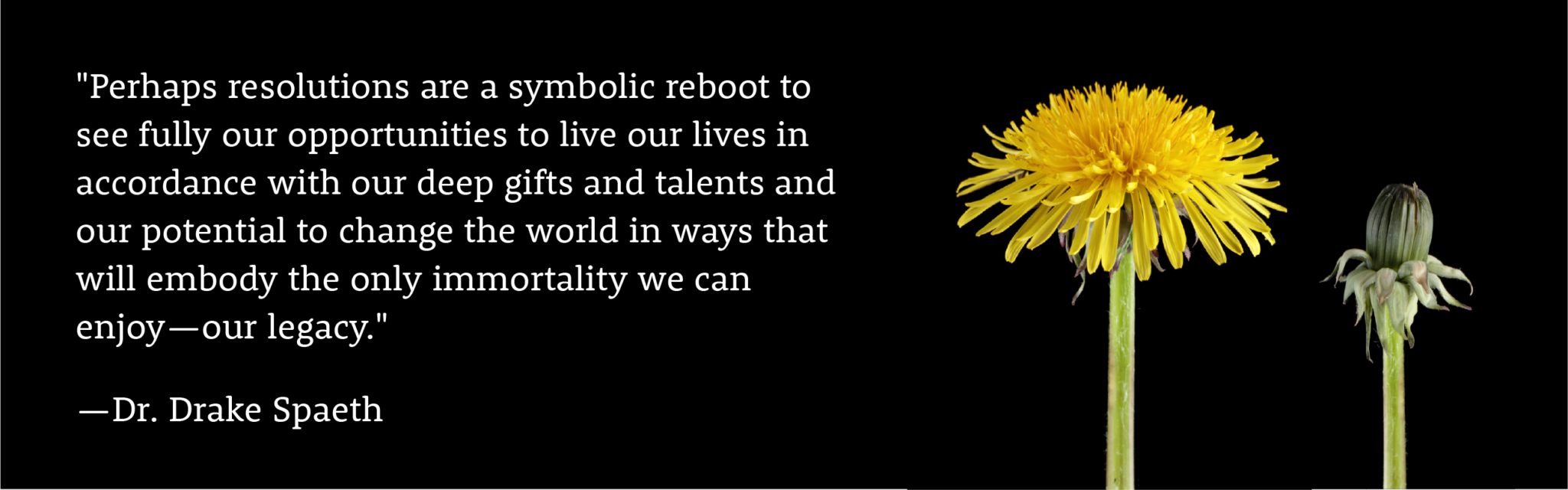
Dr. Spaeth further discusses the true meaning behind resolutions: “Perhaps resolutions are a symbolic reboot to see fully our opportunities to live our lives in accordance with our deep gifts and talents and our potential to change the world in ways that will embody the only immortality we can enjoy—our legacy.”
With this in mind, what will come from resolutions set at the close of the year?
“To have a day or a time where we formally let go of what no longer serves us and embrace what we are becoming is a powerful and sacred opportunity to align ourselves with the rest of the natural world and what is happening all around us,” Dr. Spaeth says. “The condition of the world right now makes painfully clear our responsibilities to empower and support each other in this endeavor as well.”
Perhaps at the close of each year, it’s more impactful to look back, reflect, and move forward with lessons learned and a resolution to improve for the better.
If you’d like to learn more about the academic programs available at Saybrook University, fill out the form below to request more information.
Early in the pandemic, patients dwarfed by machinery and medical equipment, the activity concentrated in the center of the room, far from the door, far from people. COVID-19—at that point an enigma yet a lethal threat—threw society into a panic that divided it, first physically, then emotionally.
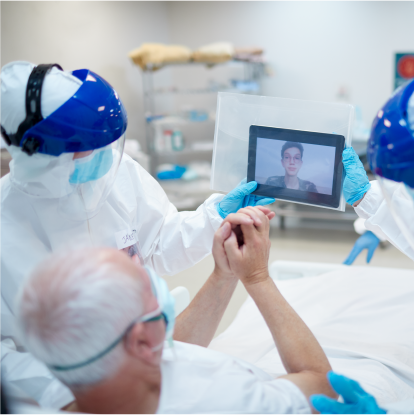
Who can forget the stories of doctors and nurses facilitating video calls for sick patients with family members who weren’t allowed in the hospital? The front line workers who were often the sole source of comfort for those shut off from the rest of civilization, ticking time bombs of germs and sources of infection?
According to a Northwestern Medicine study, patients who died from COVID-19 in 2020 were almost 12 times more likely to die in a medical facility than patients who died from any cause in 2018.
The new study analyzed data from the Centers for Disease Control and Prevention for deaths related to COVID-19 from February 1, 2020, to May 23, 2020, and found
0
died in medical facilities
0%
died in nursing homes
0%
died at home
0%
died in hospice facilities
Three distinct perspectives come into play here: the person who is dying, the loved one who is grieving, and the medical professionals who are acting as the bridge (and therefore, taking on some emotional burden). While many media stories focus on dying alone, not many have centered on the aftermath and the people who are left behind. At the same time, we see plenty about the potential PTSD health care professionals are up against, but little on how to manage while we are still in the heart of the pandemic.
This sense of loss isn’t barred to just the health care sector. Loss is synonymous with 2020. Wildfires and hurricanes. Canceled milestone events. The heightened response to police brutality.
“Loss is what occurs when we experience a separation, while grief is a healthy and expected outcome when we experience loss,” says Gina Belton, Ph.D., a psychology faculty member at Saybrook University. “On a collective and personal level, there has been loss of employment, loss of housing, loss of certainties that we believed were present that would offer stability—and there is deep grief around that. In times of great catastrophe, we often rely on the support of community, but simple acts of being neighborly or relying on our community can put us at risk. We now have a whole generation of people trying to navigate how to experience grief and loss. It’s monumental.”
Social isolation, grief, and loss are now all shared experiences for so many. And while we’re experiencing them at the same time, for the first time we’re largely all apart—which adds another layer to the grieving process. With loved ones far, other people have become involved in new and creative ways, like health care professionals acting as proxies for patients, or family members finding community and camaraderie online. Addressing this grief, and preparing for these new roles, have become so much more of a necessity.
We must rethink end-of-life care and grief. COVID-19 has offered a natural reset point—connecting us all through this shared experience. We need to creatively reimagine ways to show up for one another before and after death. If 2020 has taught us anything, it’s that we may not be together, but we’re also not apart.
Grief and loss a world away
Kari Rogenski, a student in the Ph.D. in Psychology: Creativity Studies Specialization, knows all too well the struggles of grieving a loss that she couldn’t be a part of. Her grandma had been living in a nursing home, battling dementia, but enjoyed visitors every day for lunch and dinner—her room welcome to Rogenksi’s dad, stepmom, aunt, and uncle. Once COVID-19 came to the nursing home, her grandma was confined to her room—the visits abruptly halted.
“Dying is not a linear regression, and grieving certainly is not a linear experience,” Dr. Belton says. “When you have a discipline that pathologizes grief and determines what it is and how long it’s supposed to last, you miss a set of complexity and volumes of human experience around expressions of grief.”
Rogenski wrote about her experience.
“[My grandma] died within three weeks of the social isolation imposed upon her by the very real threat of COVID-19. Though my family was permitted to say their goodbyes within the 24 hours before her death, and my aunt was present when she passed, one simply can’t help but name that she died indirectly from coronavirus and the social isolation that is the sad truth for millions of older adults around the world.”
For Rogenski, who lives in a different country, the possibility of going home to see her dying grandmother was nonexistent. Her grief is an encompassing, solitary, and ongoing process.
“It does not feel complete. It became clear to me after my grandmother’s death that I needed to recreate as much authenticity in my experience at home as possible. For me, this included many of the rituals that my family was going through in Canada that I could replicate in my home in California,” she wrote. “All of these things allowed me to grieve as authentically as possible given the distance, but the truth is it’s still very hard. Not being able to hug your loved ones when someone important dies, and not being permitted to travel home, will take time to overcome. I also think my grief process will feel more complete when I do get to travel back to Canada, visit her graveside, bring her flowers, and spend time with my family in person.”
Rogenski is not alone in this process. With hundreds of thousands of American losses to COVID-19, nearly 2 million across the country are grieving. For others overwhelmed with grief—or even resistant to it, as Dr. Belton notes, which is common in Western culture—and unable to connect with loved ones, this process is paralyzing. While some may turn to the purported five stages of grief to explain their feelings—denial, anger, bargaining, depression, and acceptance—Dr. Belton reminds us that Elisabeth Kübler-Ross developed these stages as a model for death long before it was acknowledged that our dying does not unfold neatly in a linear fashion. Grief isn’t something to be categorized and neatly fit into boxes only to be packed up and eventually put away.
“Dying is not a linear regression, and grieving certainly is not a linear experience,” Dr. Belton says. “When you have a discipline that pathologizes grief and determines what it is and how long it’s supposed to last, you miss a set of complexity and volumes of human experience around expressions of grief. Not all cultures are death denying either.”
Additionally, bereavement and mourning are often culturally driven and constructed. Dr. Belton brings her own indigenous background to share an alternate perspective to our idea of death. At the center of her grief experience are integrative approaches of relationality and interdependence. She understands that a healthy response to loss is grief and honoring what grief brings to the bereaved fully.
“In general, as a social scientist and ethnothanatologist, what I’ve observed in Western American society is this resistance to suffering. It’s challenging to be openhearted and curious when you are resisting it. The fact of the matter is that grief is painful, and loss is painful, and people don’t want to suffer or feel vulnerable. But those kinds of awareness open us up to a wider and deeper view of end of life.”
Creating essential connection
Health care professionals have become a part of the end of life—and grieving—journey for many patients and families out of necessity. In an October 2020 study published in the Journal of Pain and Symptom Management, only 13% of families or relatives were present at the time of death in nursing homes, 24% in hospitals. 59% of COVID-19 patients had someone present at the time of death, compared to 2019 when that figure was 83% for people in nursing homes and hospitals.
0%
of COVID-19 patients had relatives present at time of death in 2020
0%
of sick patients had relatives present at time of death in 2019
While incorporating dignity into care has always been integral in health care, this has never been more imperative than during the COVID-19 pandemic.
Before Dr. Belton became a grief and bereavement specialist, she had served as a nurse for more than 20 years, including a professor of nursing in one of only 13 holistic nursing programs in the country. Discussing this experience and her training for it, as well as her subsequent research in ethnothanatology (the study of death across cultures), she sees ways that health care professionals can adjust their own perspective to improve end-of-life care.
“When I was a nurse and I practiced in an acute care facility, I noticed how a lot of my colleagues were struggling. In my research, I observed that there was a fundamental lack of awareness of our relationality to the patient,” Dr. Belton says. “The culture of the biomedical model, and its primary goal, is to fix. And that showed up in my research very clearly—every nonindigenous physician described that they needed to fix the patient. When I reviewed my transcripts for the indigenous participants, however, respecting the patient was most important to them.”
A medical culture that focuses on “fixing” leads to health care workers distancing themselves from the experience they are living through with their patients. Western culture’s resistance to suffering has been prevalent in medical care. This especially comes into play considering that families are often unable or not allowed to be by the bedside and advocate for their loved one. Some health care professionals zero in on an intended result rather than truly seeing the person in front of them—and in times of COVID-19, with so many sick having so little support, a change in approach is necessary.
This isn’t to say that health care professionals aren’t suffering either. They’re facing a wave of potential PTSD and moral injury as a result of hospital restrictions to reduce the spread of COVID-19.
A narrative review and conceptual framework published by the Annals of Internal Medicine uncovered seven concrete ways to protect clinician mental health: resilience and stress reduction training, providing for basic needs, specialized training for jobs that changed due to COVID-19, clear communication from leadership, strategies to address moral injury, peer and social support interventions, and mental health support programs. However, with these solutions spanning from the individual level to a structural one, widespread implementation while still in the midst of the pandemic presents a near impossible challenge.
Being creative in our collective grief
Grief, in its nature, feels lonely. Punctuated by loss, humans feel an absence deeply, burrowed in sadness that feels individual and unique only to them.
“We see this with the stories of all of our nurses and physician colleagues and aides and the ancillary folks who were there in the hospitals acting as our interim intermediaries,” Dr. Belton says. “They’re learning really fast how creative they can be to meet this need, to bridge the experience with iPads, notes, and telephones.”
We see it in ourselves, in our colleagues, in our co-workers, acquaintances, the friendly faces we used to see on commutes and at places we used to frequent, and in bearing witness to the losses that have defined 2020. It all goes back to the idea of this collective grief that has gripped our world.
But in sharing and holding this grief, in being witnesses to all that has come from this year, there is great opportunity to be creative and expand our idea on how to provide community to one another and support each other in this time of need.
“We see this with the stories of all of our nurses and physician colleagues and aides and the ancillary folks who were there in the hospitals acting as our interim intermediaries,” Dr. Belton says. “They’re learning really fast how creative they can be to meet this need, to bridge the experience with iPads, notes, and telephones.”
Rogenski has seen this creativity too firsthand in her role as director of The Hummingbird Project, a therapeutic activity program committed to supporting older adults and those living with dementia through cultivating joy, engaging curiosity, and fostering personal expression.
“With COVID-19, we quickly pivoted (practically overnight) to offering our program virtually, growing our service delivery model to be able to provide services through technology across the nation, and still seeing clients in person as we are able safely wearing masks and PPE,” Rogenski explains. “Our strategy today includes our on-on-one virtual and in-person activity program, virtual group programs, education and advocacy, and providing more resources than ever before. I remain inspired, amazed, and overjoyed by the ability of our team and those we work with to embrace this change and have fun and find joy despite it.”
Rogenski hopes the pandemic brings light to the negative impact of social isolation and loneliness.
“My journey through my grandmother’s experience living with dementia and then dying during the pandemic—I believe due to the social isolation she experienced—has raised many questions in my heart and mind,” she wrote. “I do not know the ‘answer,’ but I do have a wish: My hope is that this pandemic has brought to light the negative impact of social isolation and loneliness for all beings. We must create a new, more holistic, more inspiring experience for our elders through embracing creative connections, defining community, and through joy. Love must win.”
Learn more about Saybrook University
If you are interested in learning more about the community and academic programs at Saybrook University, fill out the form below to request more information. You can also apply today through our application portal.
The Garden of Eden, the Hanging Gardens of Babylon, Johnny Appleseed’s trees, Washington’s Mount Vernon, Monet’s Gardens, Thoreau’s Walden Pond, Louis XIV’s Gardens at Versailles. Our deep connection to nature is nothing new. But in the spring of 2020, in the midst of the first COVID-19 wave, some Americans reawakened to that connection. The week before the lockdown began, garden suppliers saw sales of plants, seeds, and bulbs hit record highs.
While some may be discovering a love of green and growing things for the first time, many made it a practice long before the pandemic. A report from Garden Research found that gardening hit a record high in 2018, with 77% of all U.S. households doing some sort of it. The same report found that millennials made up 29% of all gardening households and that at least one houseplant lives in 30% of all homes.
With society largely relegated to their homes for much of the year, enthusiasm for gardening has grown. Whether it’s people trying their green thumb with a few succulents or expert cultivators expanding their garden beds, the benefits are unambiguous: Caring for plants is good for us in almost every conceivable way.
The gifts of growing
Research has shown that plants have a power to decrease pain and stress that seems almost magical. Many of the benefits seem quite logical—like how gardening outdoors provides moderate- to high-intensity physical activity and increases your vitamin D intake. Other more fascinating benefits abound as well. A 2015 study found that plants in a workplace boosted creativity, productivity, and positive feelings. How can something as simple as a houseplant have such healing effects?
Immersed in the outdoors and medicine for more than 30 years, Kimberly Allen is a Ph.D. candidate at Saybrook University studying Mind-Body Medicine and Integrative and Functional Nutrition. She’s a kayaking and mountain climbing instructor, while also holding certifications as an emergency nurse and a family nurse practitioner. She also happens to be well-acquainted with the power of plants.
Allen notes that gardening offers its own physical benefits. “Gardening does more than just enhance our overall sense of mental health and well-being,” she explains. “Physiologically, exposure to soil is great for our microbiome. Exposure to soil bacteria such as lactobacillus and bifidobacteria are known to increase cognition and boost mood. So we gain a sense of calm and happiness by just inhaling the soil without even knowing it.”
“I think we understand intuitively how plants benefit us. There’s something that seems to really resonate right now for people with plants during COVID-19,” Allen says. “I see the way people are buying houseplants and seeds now as similar to how traditionally people brought evergreen into their homes in the dark days of winter. We’ve done this for centuries, and science is just recently giving us a little insight into why.”
Long before Christianity began the celebration of Christmas, many civilizations brought trees that remained green inside their homes. Some cultures believed that evergreens would keep away witches, ghosts, evil spirits, and illness, and research is showing now, that in a way, the illness part may be true. A study published in 2012 found that trees, flowers, vegetables, and fruit produce antimicrobial chemicals called phytoncides. These chemicals are an immune reaction to ward off predators, but they have a tonic effect on humans—boosting our immune systems while lowering our stress response.
Terri Goslin-Jones, Ph.D., lead faculty of the Creativity Studies Department at Saybrook and an avid gardener, elaborates on the cause and effect of our relationship with plants.
“Gardening promotes exercise and being in nature, which leads to fitness and often healthier eating, which then decreases risk of illness,” Dr. Goslin-Jones says. “You’re getting out in the sunshine and fresh air. Gardening is holistically great for us.”
Plants and us
In 1974, Dr. Edward O. Wilson argued in his book Biophilia that humans have an intense, innate attraction to nature and living things. As much as humans respond to plants, plants respond to us—whether that response is a simple reaction to care or neglect, like perking up after a watering, or the more complex responses that research is just starting to explore, like whether plants have memories or respond to sounds.
“As you start to look at nature and plant life as part of the universe, there is this intuitive communication that we might not be aware of in everyday living,” Dr. Goslin-Jones says. “But once you start to immerse yourself with a plant inside your house or outside, it starts to interact with you in a very unique, special way.”
Empirical research into the intelligence and responsiveness of plants is still in a fledgling stage, but it makes sense that caring for a living thing can have deep mental and emotional benefits for people of many different walks of life.
Spending time in a garden was shown to improve short-term memory in patients with advanced dementia, and prisoners who took part in green prison programs in which they gardened and spent time with plants had 10% lower recidivism rates. One study also found that nature-based activities could be useful in treating post-traumatic stress disorder symptoms.
“We’re creating relationships when we care for something. When we care for a plant, we create a relationship with that plant. When I begin to talk to people about the healing benefits of spending time in nature, they will start to open up and often say things like, ‘I love to go on walks with my dog,’ or ‘I like to sit on the porch in the evening.’ I get to reaffirm that yes, what you are doing is wonderful. Keep doing that. It’s really, really good for you,” Allen says.
Plants also mirror the facts of life back to us, showing the effects of nurture and neglect. For people suffering from depression, anxiety, or other mental disorders, plants can offer a source of connection and meaning—literally, a reason to get up in the morning.
“If you start to care for a plant, it can offer a new mindset,” Dr. Goslin-Jones says. “You plant them; you’re nurturing them; you’re excited to see their buds and their growth. Now you’re connecting with the plant life and to the physical world. You offer compassion and care to something that is giving you feedback. Plant life offers increased awareness of nature, including our inner nature.”
Nature and creativity
A deep connection between art and nature goes back to the earliest instances of human song, painting, and storytelling. Our language is bathed with the imagery of the natural world generally, and plants specifically, where love blossoms and we reap what we sow. The natural world has served as the inspiration of countless great works of art, from Monet’s water lilies to Vivaldi’s Four Seasons. Looking back over centuries of global art, it’s easy to see the myriad ways that plants, gardens, and nature have inspired painters, composers, and poets throughout human history.
As head of the Creativity Studies Department, Dr. Goslin-Jones is most interested in the way creativity and gardening go hand in hand. She also has firsthand experience of the creative impulse that comes from the natural world.
“Gardening has a design element of color and texture,” she says. “It’s like painting for me, painting with plants to create this visual landscape that comes together to make a beautiful whole. That leads to inspiration in other areas—that garden then inspires me to write poetry or to paint or to travel. It really inspires all parts of my life and in all seasons of my life too.”
Not only do plants inspire us to make art—making art is incredibly good for us. Studies have shown that drawing reduces cortisol levels and improves mood, and a 2018 study found that writing about stressful or traumatic events was good for both physical and psychological health. Art therapy has also been successfully used to treat eating disorders, addiction, and chronic illness.
Additionally, making art can put us in a “flow” state—a term coined by psychologist Mihaly Csikszentmihalyi to describe the experience of being “in the zone,” or the pleasurable feeling of total immersion in a task. A 2008 study on the brains of jazz musicians found that in a flow state, the self-monitoring portion of our brain is turned off, allowing for split-second decisions and essentially uninhibited creativity. Another study found that classical pianists who entered a flow state exhibited deeper breathing and a lower heart rate. Physical activities like gardening, exercising, and yoga are also lauded as ways to get into the flow.
“There’s a level of immersion, a meditative state, to gardening and being in nature,” Dr. Goslin-Jones says. “Monet is a wonderful example of this. I traveled to his gardens, and it’s almost a mystical experience. When you see his painting, he’s the ultimate example of getting inspiration from gardening. His whole life is suffused by gardening.”
The holistic benefit cycle
The positive effects of plant and human relationships connect and feed into each other—from creativity to holistic health. Gardening or spending time in nature pays physical benefits in exercise, sunshine, and fresh air.
Exercise, sunshine, and fresh air feed the mind-body connection, boosting our immune systems while also improving our moods and mental resilience. At the same time, plants and nature make us more creative and productive, setting off another string of mental and emotional benefits.
If gardening is the prescription for some of what could ail you, how much is prescribed? The truth is that even tiny doses of plants, sunshine, and fresh air can make a major difference. A 2009 study found that hospital patients with a houseplant in their rooms had lower blood pressure; less pain, anxiety, and fatigue; and more positive impressions of the employees caring for them.
Even in the sanitized stupor of hospital rooms, minor changes like a single plant or staying on the sunny side of the hospital can have positive effects.
If you’re planting a garden bed in a yard or a community garden, going for a hike, taking a walk to a green space, buying a succulent, or adding a few houseplants around a workplace or home, you are likely to receive the same restorative and inspiring benefits. In 2020, when 40% of Americans report experiencing a mental or behavioral health condition related to the coronavirus pandemic, these benefits are all the more important.
When travel, eating out, and many of the “normal” ways we socialize and relax are out of reach, buying a few houseplants to keep you company are can brighten our days and decrease the stress many of us feel. With so many unknowns surrounding us, one clear promise is the bulbs will bloom in the spring and the seeds will bear fruit again, and by witnessing these miracles, we can remain invigorated.
Learn more about Saybrook University
If you are interested in learning more about the community and academic programs at Saybrook University, fill out the form below to request more information. You can also apply today through our application portal.
Marie Kondo started a revolution nearly a decade ago with a simple concept: Clean out your house. Get rid of things. If it doesn’t spark joy, throw it out. Meanwhile, experts believe that one in 20 people in the U.S. could be clinically diagnosable hoarders. The average American home contains 300,000 different items. Seemingly from birth, as Americans, we’re taught that we need things. All of them. For most of the 20th century, this sort of overconsumption was largely lauded—there were no ramifications, at least none that we could see.
And then we noticed the world was on fire—or melting, or maybe both. Simultaneously.
On April 22, 2020, we celebrated the 50th anniversary of Earth Day and week six of our pandemic-induced lockdown. Our time inside presented an opportunity to consider the ways that overconsumption and care for our Earth go hand in hand. According to NASA satellite readings, levels of nitrogen dioxide were down by as much as 30% in China in January. Meanwhile, with fewer cars on the road, Los Angeles’ smog lifted, and according to Environmental Protection Agency data, the city experienced its best air quality in almost 40 years. Across the world, the famed Venice canals sparkled, and in Delhi, a city where people wore masks because of car pollution, residents saw actual stars. Pictures abounded of clear skies and wild animals inhabiting green spaces again—making it difficult to deny that our everyday actions were affecting the environment.
Why we need
Our need to collect things stems back to how we evolved. In our fight to survive, we learned that collecting more food, more blankets, and more shelter made us more likely to stay alive and more likely to attract a partner. This behavior to consume had no limits.
The evolutionary need to keep consuming has turned into overconsumption. People buy more than what they need, and because the world is not an unlimited resource, the effects are far reaching.
Economist Thorstein Veblen explored the tendency to overconsume in 1899, applying it to class distinctions. He wrote, “The motive is emulation—the stimulus of an invidious comparison, which prompts us to outdo those with whom we are in the habit of classing ourselves.” Essentially, we continue to want more so that we can show that we can afford more.
The phrase “Keeping up with the Joneses” comes to mind.
Linda Riebel, Ph.D., ecopsychologist and Saybrook alumna and faculty member, equates this to an addiction. “For some people, purchasing something, no matter how trivial or useless, brings a jolt of satisfaction, even happiness. For others, the act of shopping is the reward, as they spend whole days at the mall—or used to before the pandemic. Addiction seems to be a plausible analog, in that each brief moment of satisfaction fades and the person feels a need for a new one.”
Our capitalist economy thrives on this need for more with advertisers and products galore. From our hunter-gatherer roots to our new life spent indoors, “things” are often tied to security—whether rightly so or not. We feel secure if we have things, and society and advertisers play on that heartily. After 9/11, President George W. Bush told us to support our country by buying things. Economy above all.
“Our economy is predicated on the notion that ‘growth is good,’ even though numerous people have pointed out that unrestricted growth is also the hallmark of cancer. Wall Street analysts predict how well a company ‘should’ do, and companies desperately try to persuade people to buy their products and services. Enter advertising,” Dr. Riebel continues.
“This is the industry—with the regrettable complicity of psychological knowledge—that batters us with phone calls, images, intrusions into our emails, tracking and selling our movements. You know the drill,” she says. “Even the urge to use less has been co-opted, such as the magazine Real Simple, stuffed with advertisements for things. Today’s online version touts cosmetics: ‘Someone Buys This Foundation Every 60 Seconds (and It’s on Sale During Amazon Prime Day!).’”
But the Earth simply cannot keep up. According to figures by the Global Footprint Network, an independent think tank, the first time that human consumption surpassed the planet’s capability to produce was December 29, 1970. This date moves forward each year, with this year’s “Overshoot Day” falling on August 22, 2020. It would currently take 1.6 planet Earths to support our demands on the ecosystem.
What things cost
When climate change was initially discussed in the late 20th century, we were told that Antarctica was melting, the polar bears had nowhere to live, and that our aerosol cans were making a hole in the ozone layer—but all of that was far away from our every day. We could turn the channel, ignore the facts, and move on with our lives. Now with dire climate disasters happening more and more frequently, it’s becoming more difficult to ignore—yet still we consume.
“Until the early 20th century, consume literally meant ‘to waste.’ So at the heart of consumerism is a willingness to not only waste food and things, but to waste people,” says Shuli Goodman, Ph.D., alumna and founder and executive director of Linux Foundation Energy.
“The mind is always going to want more because that is what the mind does. The mind always wants to grasp more, but what is unique about the United States is that we’ve been able to produce more and more because of our natural resources,” Dr. Goodman says. “But a lot of people don’t recognize that at the heart of the American experience is Manifest Destiny, which is everywhere we look—Target, Amazon, everywhere. I want, therefore I can have.”
Even with the impressive, unexpected benefits to nature after our imposed lockdown, thanks to ecommerce, consumerism and overconsumption did not miss a beat. According to the Digital Commerce 360 analysis of U.S. Department of Commerce data, figures show that in the first six months of the year, consumers spent $347.26 billion online with U.S. retailers, up 30.1% from for the same period in 2019. Online spending represented 18.6% of total retail sales for the first two quarters of 2020. Another market that is known for single-use products, which is harmful for the environment, is also rising during the pandemic: food delivery. Grubhub reported a 35% increase in active diners—from 20.3 million in 2019 to 27.5 million in 2020.
Dr. Riebel even links overconsumption of the Earth’s resources to eating disorders in her 2001 liminal paper, “Consuming the Earth: Eating Disorders and Ecopsychology.” She writes, “Consumption of the earth’s natural resources exists in its starkest and most literal form in the act of eating. Eating disorders are symbols and manifestations of psychopathology on a grand scale, made more poignant by the fact that they are so difficult to cure.”
Curing the ills we’ve caused Earth may be just as difficult, but it doesn’t mean we mustn’t try. Dr. Goodman works in the energy field, finding ways to move into a renewable, sustainable market to produce and democratize power. She believes that looking through a historical lens, we can begin to understand the damage we’re doing.
“We have lost our historical context: Why we came to this country, what we were looking for, and the degree to which we have succeeded,” she says. “We’ve been soothed into complacency because of our ability to live like kings and queens and go buy, buy, buy. There’s no other way to think about climate change than by thinking about our materials and what we use to create these things to consume.”
Wants ≠ needs
A recent headline read that the United Nations “warns that world risks becoming ‘uninhabitable hell’ for millions” if nothing is done. “Consumerism is relatively new and directly related to fossil fuels. If you look at the kind of exponential growth curve of fossil fuels, the GDP, and carbon, they follow exactly the same curve, starting around the 1850s,” Dr. Goodman says.
The climate crisis is a direct reflection of our need for more. According to the UN Office for Disaster Risk Reduction (UNDRR), 7,348 major natural disasters occurred between 2000 and 2019—including earthquakes, tsunamis, and hurricanes—claiming 1.23 million lives, affecting 4.2 billion people, and resulting in $2.97 trillion in global economic losses.
Overconsumption and its effects are everywhere. We can talk about the use of plastic: an average person living in North America or Western Europe consumes 220 pounds of plastic each year, mostly in the form of packaging, compared to one-fifth that level in Asia. Or we can discuss the rising levels of debt—financial company Nerdwallet reports that the average American household is $132,529 in debt. Or about binge drinking (consuming more than four drinks in one sitting) accounting for 90% of the alcohol consumed by those under the age of 21 in the United States.
Overconsumption and its effects
0lbs
of plastic are consumed each year by an average person living in North America or Western Europe
$0
is the amount of debt the average American household has.
0%
of alcohol is consumed through binge drinking by those under 21 in the U.S.
Learning to limit our consumption of anything does not appear to come easily to Americans.
“We consume the Earth to ease our pain. But the success of this strategy is fleeting—the pain comes back, so we do more of the same, demanding more consumption-induced oblivion. Attempts to stop merely reinstate the cycle,” Dr. Riebel writes. “We become ever more disconnected from our bodies, our fellow humans, our fellow creatures, and our self-respect. Humans are not always rational and, as the environmental crisis shows on a ghastly scale, are capable of ignoring even the most elementary factors needed for survival.”
Though it may not have been part of our evolutionary development, the humanistic foundation that Saybrook has relied on for more than 50 years provides a way through this crisis. While a focus on altruism and providing for others cannot provide a cure for the climate crisis, it does provide our only hope of survival.
“If you begin to change systems, to democratize energy and electricity, if you stop pumping the bones of our ancestors into our cars so we can drive to the mall, if you do that, it will have a profound shift on how culture is organized,” Dr. Goodman says. “I trust that if we begin to address this at a structural level, many things will change, and it will begin to cascade its way down. On a day-to-day basis, we vote with our dollars. I think that we have to begin taking responsibility for every single day we vote for something with what we spend our money on.”
Learn more about Saybrook University
If you are interested in learning more about the community and academic programs at Saybrook University, fill out the form below to request more information. You can also apply today through our application portal.
2020 has been a year of compounding catastrophes. As of this writing in November, the COVID-19 pandemic has killed hundreds of thousands of Americans, and the economic ramifications have leveled families, businesses, and entire industries. In parallel, the country is experiencing a long overdue reckoning on racial justice as citizens express outrage at the continued lack of accountability for police officers who harass and assault communities of color.
How to adapt to changes, and to ultimately overcome such adversity, is a prospect with which many industries, including the business world, are all too familiar. In 2019, Gartner, a management consulting firm, surveyed business leaders and found that typical organizations today have undertaken five major firmwide changes in the past three years—and nearly 75% expected to multiply the types of major change initiatives they would undertake in the next three years.
From rebranding to new leadership to major pivots of their business models, millions of organizations around the globe endure large-scale institutional change. To navigate through these times of uncertainty, knowledgeable executives practice “change management,” a process Harvard Business School defines as “the method of leveraging change to bring about a successful resolution.” In fact, in 2017 businesses spent more than $10 billion dollars on change management consultancy.
As 2020 draws to a close, it is not that difficult to see the United States as a giant corporation undergoing organizational change—all the while enduring a global pandemic. Is it possible to apply the tenets of change management to how we might adjust as a country and ultimately prevail?
What we don’t know
What makes the current state of global affairs in the midst of the novel coronavirus pandemic particularly stressful is the degree of uncertainty.
And there is no easy fix, no “cure” around the corner that can be implemented and become effective. Even with a safe and successful vaccination, the speed of distribution and the pace at which the economy will recover are both still in question. A September 2020 Pew Research Center poll found that only 51% of U.S. adults said they would “definitely or probably get a vaccine to prevent COVID-19 if it were available today,” with 49% saying they “definitely or probably would not get vaccinated at this time”—a reluctance many attribute to the politicization of the vaccination process.
“The polarized mind is about a fear-driven move toward the perception of absolutism, certainty, and sameness,” says Kirk Schneider, Ph.D., psychology faculty member at Saybrook and author of The Depolarizing of America: A Guidebook for Social Healing. “This is why people who are polarized tend to cluster in groups of people who are similar to them. You have these echo chambers and cultural silos because they feel safer.”
But in addition to bridging divisiveness, the fact remains: Much about the near future is unknown. During times of extreme uncertainty—no matter the reason—Tom Hayashi, Ph.D., chair and program director of the Department of Leadership and Management at Saybrook University, believes an “adaptive leadership” approach is the best way forward.
In short, it requires thinking on your feet, coalition building, and taking ownership while addressing the people factor—all tactics that Dr. Hayashi has found fruitful in his consultations and research in the field with organizations during COVID-19.
Part of most action plans right now include moving services online—but they also need to include holding conversations with all participants in the decision-making process, which makes a significant difference in how programs are implemented.
“Plans should be in response to external and internal customers. A way to, in real time, display adaptive strategies and leadership,” Dr. Hayashi says. “Organizations can effectively adapt in the midst of a crisis situation by paying attention to not only the technical aspects of organizational pivot but to ensure that the focus is on the most important asset, its people. Research in change management has consistently shown that dedicated attention and investments in the capabilities of the workforce such as leadership and team coaching as an integral part of systems and process adjustments can significantly enhance productivity by 30% and reduction in attrition by as much as 50% … ultimately effective adaptive leadership translates to positive people and profit outcomes when organizations can really use every break they can get in times of the global pandemic.”
Who we’re talking to
Another key component of effective change management is diversity: diversity of thought, diversity of identity, diversity of talent. By incorporating such diversity into a group tasked with making change, leaders have access to a wider variety of perspectives and, in turn, can adjust their strategies accordingly.
Think of it this way: In a work environment, if employees don’t feel understood or valued, then culture, productivity, and retention can suffer. In fact, a 2018 report from McKinsey and Company found that public companies in the top quartile for ethnic and racial diversity in management were 35% more likely to have financial returns above the industry average, and those in the top quartile for gender diversity were 15% more likely to have returns above the industry average.
For both government officials and business executives, the proof is in the pudding: When leaders invest in diversity, it pays dividends.
“One of the phrases I use with my clients is ‘Be a listening, learning leader,’” says Saybrook University Board Trustee Joanne L. Smikle, Ph.D. “Do not walk in pretending that you know it all, that you have all the insights in the world, and that you are the fount of all knowledge. Leaders have to be open to hearing different perspectives. It’s important to find and prioritize fresh voices.”
It’s a widely accepted tactic of adopting changes in business to listen to those who the change is going to affect—aptly named an open-source approach. By ensuring diverse voices and making them a part of conversation, research shows that successful implementation grows by 22%.
“I think people need not fear what they have a voice in,” Dr. Smikle adds. “So the question is, ‘What are you going to do to actively solicit input and insights from lots of different people?’ It’s like when I work with clients on strategy, I say, ‘Do not think because you are an executive at this company that you are necessarily the best person to guide strategy or know what is best for the organization. The people close to the work have a level of intelligence that the people at the top of the house don’t have. Let’s hear from those people. Let’s invite them into these strategy sessions. Let’s invite them to shape the future of this organization.’ It’s the same model for this country.”
One of the resonating values of civil progress has long been increasing the voices that are heard—and it’s easy to understand that as a nation, our success with dealing with these rapid changes is much more likely to be successful by incorporating valuable insight from all communities.
Who is listening
The American Society of Quality defines change management as “the methods and manners in which a company describes and implements change within both its internal and external processes. This includes preparing and supporting employees, establishing the necessary steps for change, and monitoring pre- and post-change activities to ensure successful implementation.” Noting that the reason most changes fail are human reasons.
Change does not happen in a vacuum.
Success and failure are largely dependent on whether or not key constituencies buy into the premise. Within an organization, employees can be resistant to change, as the status quo is oftentimes more comforting than the prospect of the unknown.
Causes for fear are abundant in today’s world, made exponentially worse by the uncertainty of it all. We don’t know how many people will perish before a viable COVID-19 vaccine emerges, or whether local, state, and national governments will actually move forward to address the racial injustices laid bare over the course of many years—not just 2020. If the unknown and uncertain inherently predispose us to fear, then it’s no wonder anxiety is at an extreme high for so many.
These dual pandemics—COVID-19 and racism—are now responsible for a sort of collective trauma. A recent CNN investigation considers the impacts that mass trauma can have on a population by revisiting the prolonged state of “chronic threat response” (the ongoing state of being in survival mode) provoked by the events of September 11, 2001. According to the World Trade Center Health Registry, roughly 20% of registrants reported PTSD symptoms many years later, indicating that the aftereffects of the coronavirus could be equally enduring.
Generations are brought together by these collective experiences while such a precarious environment also has the potential to drive individuals into polarized cultural vacuums, where oversimplified answers (think so-called miracle “cures” like hydroxychloroquine) are offered as confident, comforting explanations to complex and confusing questions.
In the context of lessons learned from change management theory, no amount of transformation can thus find success without first unifying preexisting divides. After all, rebuilding this country will be a collaborative process. The message of “together we can fix it” is sure to have a much broader appeal than the long-standing “only I can fix it” idea.
“Before change, there must be healing,” Dr. Smikle says. “You are not going to get buy-in in a fractured organization. You need to understand who your constituency is, work to strengthen those relationships, and once you’re sure those relationships are strong, work on cultivating new relationships.”
Change en masse
Between March 1933 and June 1944, President Franklin Roosevelt gave 30 fireside chats, intimate addresses broadcasted on radios across the U.S., on topics ranging from unemployment and economic policy to the looming threat of fascism. In the early days of mass media, it afforded the president a way to communicate directly with the public, securing support for the ambitious agenda of his first 100 days in office.
Such regular, informal entreaties allowed Roosevelt to exhibit accountability through transparency, as Dr. Hayashi suggests, and to showcase his skills as a listening, learning leader, as Dr. Smikle advises. He offered clear-cut plans to ease collective fears and referred to the American public directly as “you,” speaking openly and frankly about shared values—working to break down the divides of Dr. Schneider’s “polarized mind.”
The idea of applying business values to our current cultural issues is one of the founding principles of Saybrook’s new MBA and DBA programs. With the new Sustainable Social Impact MBA and DBA degrees, the university continues doing the work toward a more equitable and just society through bridging business success and social consciousness.
“We are not interested in just looking at a single bottom line but looking holistically at the world. We believe in the quadruple bottom line: People, Planet, and Profit guided by Purpose,” Dr. Hayashi says. “From change management being applied to the big issues our nation faces such as police reform, to enhancing diversity, equity initiatives within a belonging framework, redesigning systems relies on mindsets beyond our own perspectives.”
The struggles our nation confronts today are on par with the Great Depression of Roosevelt’s time and once again require a trailblazing solution. As a savvy adaptive leader, FDR was able to execute on those tactics and turn the country around by unifying and connecting citizens, which we know is the only path forward.
In 2016, Harvard Business Review reported that 70% of transformational changes fail. The principles of change management are nothing new—but rather, they offer a universal playbook for governments, organizations, and individuals alike coping with transformation in turbulent times. And perhaps, therein, offer some sort of comfort. As Roosevelt famously said in his very first fireside chat, “The only thing we have to fear is fear itself,” and now more than ever before, we must not be afraid of what lies ahead.
Learn more about Saybrook University
If you are interested in learning more about the community and academic programs at Saybrook University, fill out the form below to request more information. You can also apply today through our application portal.
To provide you the best possible experience, we use cookies and other technologies on this site to enhance your experience and improve our marketing efforts. By continuing to use the Saybrook University website, you agree to how we use your data to improve service and user-experience. Learn more: Website User Privacy Notice.
Functional
Always active
The technical storage or access is strictly necessary for the legitimate purpose of enabling the use of a specific service explicitly requested by the subscriber or user, or for the sole purpose of carrying out the transmission of a communication over an electronic communications network.
Preferences
The technical storage or access is necessary for the legitimate purpose of storing preferences that are not requested by the subscriber or user.
Statistics
The technical storage or access that is used exclusively for statistical purposes.The technical storage or access that is used exclusively for anonymous statistical purposes. Without a subpoena, voluntary compliance on the part of your Internet Service Provider, or additional records from a third party, information stored or retrieved for this purpose alone cannot usually be used to identify you.
Marketing
The technical storage or access is required to create user profiles to send advertising, or to track the user on a website or across several websites for similar marketing purposes.