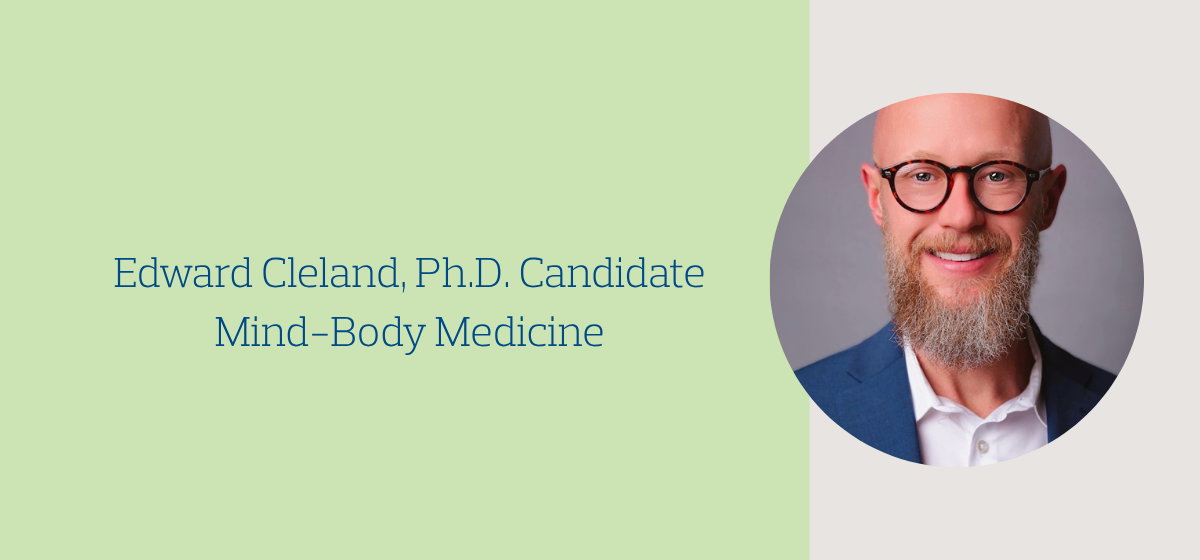
Saybrook Ph.D. in Mind-Body Medicine student Edward Cleland supports elite performers from esports champions to Olympic athletes.
Edward Cleland is a mind-body medicine practitioner and the clinical director at Mind Body Medicine of Michigan, in Rochester Hills, Michigan, which specializes in pain management and longevity. He is also the leader of Mind Body Performance, a small team of practitioners who travel around the globe supporting professional athletes, professional video gamers, executives, musicians, and chess grandmasters in wellness and performance capacity. He is currently pursuing a Ph.D. in Mind-Body Medicine at Saybrook University to maximize his own performance as a practitioner as he seeks to help others improve theirs.
Giving High-Performing Clients an Edge
The Mind Body Performance team’s portfolio of clients began growing rapidly after they received a call from a man who been referred by one of their clients. The caller owned a video game team and wanted Cleland’s team to work with his esports athletes. Given his grounding in functional nutrition, Cleland knows full well that video gamers are not generally known for their dietary discipline; however, he explains, “At the elite level, these gamers are playing in front of crowds of 20,000 fans, and they're making good incomes and careers of it. They recognize the benefit and importance of things such as nutrition, psychophysiology, mental health, and managing their stress loads.”
Through that entry point into high-performance support, Cleland and his team expanded to other esports teams around the world. Those successes led to opportunities with athletes in other sports and with chess grandmasters. Through his experience across a wide range of competitive fields, Cleland has learned that while there are certain foundational principles, successful approaches to maximizing performance vary from competition to competition and from competitor to competitor. A day in the life of a hockey goalie facing a 100 mile-per-hour slapshot is different from that of a chess champion who may wait 40 minutes between moves, and Cleland and his team tailor their approach to suit each one.
Learning the Foundations of Mind-Body Medicine
For Cleland, the Ph.D. program in Mind-Body Medicine at Saybrook University felt like the next natural progression as a practitioner in his field. “The program had a lot of qualities to be admired,” he explains. “I found their biofeedback area to be particularly beneficial and the psychophysiology, the actual chemistry and the biology of it, were helpful in my growth and maturation as a practitioner.”
Specifically, those disciplines helped Cleland understand the research behind concepts such as heart rate variability (HRV). “And not only understanding them from an academic standpoint,” he says, “but being able to translate that in a way that the patients can understand and can put to use as well.” Cleland credits Saybrook faculty Cynthia Kerson, Ph.D., who is an industry leader in biofeedback, and Luann Fortune, Ph.D., who he says, “helped me become passionate about wanting to pursue this field in this way.”
As a practitioner whose job it is to challenge his clients to perform their best, Cleland says he found that Saybrook’s research department challenged him the most. “From an academic standpoint, the rigors of pursuing a Ph.D. are not for the faint of heart,” he says. “You have to be on top of your game.”
Cleland recalls there were times when, given his experience as a writer and a practitioner, he felt was doing good work and yet the faculty continued to push him to the next level. In the end, he says, “The research department made me feel like a complete student. They made me feel like I really had earned my degree.”
At the Center of the Growing Esports Universe
As Cleland begins the process of writing his dissertation, his practice and his clients are reaching new heights. He is the lead practitioner for the United States Olympic Esports team, which he expects to become an Olympic sport in the coming decade. In November, he will be traveling to Paris for the first-ever Esports World Cup, [IM1] which will include a range of games, including chess. Cleland will be there with his client, chess grandmaster Hikaru Nakamura, who will represent the United States.
More broadly, Cleland hopes to extend his organization’s educational reach, not just at the elite professional level, among elite athletes and professionals in high-stress performance settings, but also to educate the youth and provide them tools and resources to navigate the pressure of striving to achieve our goals. “We have several projects around the world to help youth and gamers in a performance capacity, and I hope to continue that,” he says. He is particularly appreciative when a client is going up to receive a trophy and says they were so dialed in on their performance they hadn’t even thought about what they would win in the end.
Cleland is hoping to publish a book on health and performance and how mind-body medicine can be applied for health and high-level mental and physical achievement. “I would encourage anyone who’s interested in mind-body medicine to understand the true validity of the practice, its reach, and its ability to help people,” he says.